Mid-Strength flora and fauna whiskies
When the mid-strength whiskies were originally released, most of them were packaged in wonderful wooden boxes. Later subsequent releases of the same bottles saw wood replaced with cardboard, and eventually, the bottles were sold without any boxes at all. Various releases exist, with grey, white and black caps.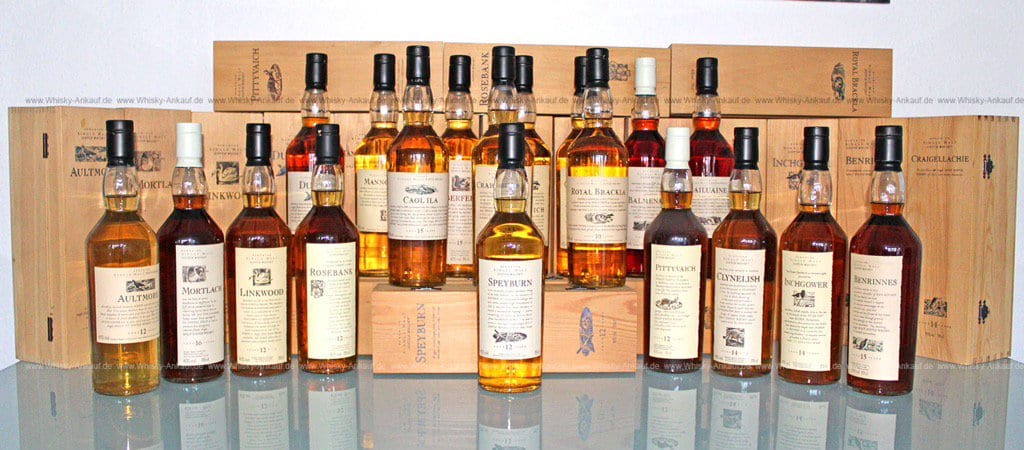
- Aberfeldy 15 years old
- Aultmore 12 years old
- Balmenach 12 years old
- Benrinnes 15 years old
- Bladnoch 10 years old
- Blair Athol 12 years old
- Royal Brackla 10 years old
- Caol Ila 15 years old
- Clynelish 14 years old
- Craigellachie 14 years old
- Dailuaine 16 years old
- Dufftown 12 years old
- Glendullan 12 years old
- Glenlossie 10 years old
- Inchgower 14 years old
- Linkwood 12 years old
- Mortlach 16 years old
- Mannochmore 12 years old
- Pittyvaich 12 years old
- Rosebank 12 years old
- Teaninich 10 years old
- Speyburn 12 years old
Cask Strength flora and fauna whiskies
In 1998, a further 9 whiskies were released, at cask strength. These whiskies were originally released with black caps, and came in gray boxes.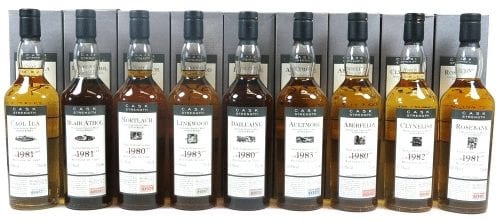
- Aberfeldy 17 years old (distilled 1980, bottled in 1997 at 62%)
- Aultmore 14 years old (distilled in 1983, bottled in 1997 at 58.8%)
- Blair Athol 116 years old (distilled in 1981, bottled in 1997 at 55.5%)
- Clynelish 15 years old (distilled in 1982, bottled in 1997 at 57.7%)
- Caol Ila 16 years old (distilled in 1981, bottled in 1997 at 63.8%)
- Dailuaine 16 years old (distilled in 1980, bottled in 1997 at 65%)
- Linkwood 14 years old (distilled in 1983, bottled in 1997 at 59.8%)
- Mortlach 17 years old (distilled in 1980, bottled in 1997 at 63.1%)
- Rosebank 16 years old (distilled in 1981, bottled in 1997 at 63.9%)
2001 flora and fauna releases
In 2001, a further 4 distilleries saw their whiskies added to the Flora and Fauna range. None of these ever came with a box.- Auchroisk 10 years old
- Glen Elgin 12 years old
- Glen Spey 12 years old
- Strathmill 12 years old
Frequently Asked Questions
The Flora and Fauna collection is a range of single malt Scotch whiskies launched in 1991 by United Distillers, now known as Diageo. It was created to introduce whisky drinkers to malts from lesser-known distilleries whose spirit mostly went into blends like Johnnie Walker.
United Distillers created the collection in 1991, the company that later became Diageo through a series of mergers. It remains one of the best-known examples of a major distiller bottling single malts specifically to showcase distilleries better known for blending.
Flora and Fauna bottlings are single malts, each coming from one distillery, while Johnnie Walker is a blend combining whisky from many distilleries. The collection lets drinkers taste a distillery’s character on its own, the same character that would otherwise disappear into a blend.
Whisky writer Michael Jackson coined the name after noticing that the bottle labels across the range primarily featured images of plants and animals, reflecting the natural surroundings of each distillery.
The original 1991 launch contained 22 different whiskies, each bottled at 43% ABV. The range was later expanded, with nine cask-strength expressions added in 1998 and four more distilleries joining in 2001.
Beyond the original 1991 mid-strength releases, a cask-strength set of 9 whiskies followed in 1998 (with black caps and gray boxes), and a further 4 distilleries were added in 2001 (none of which came with a box).
Bottlings from distilleries that have since closed, such as Pittyvaich, carry a premium because no new stock will ever be produced. Speyburn is similarly collectable, since it was sold off by United Distillers shortly after its Flora and Fauna release, leaving only a limited number of bottles.
Yes. Some distilleries in the range have since closed, making their Flora and Fauna bottlings collectible. Pittyvaich, for example, has closed and been demolished, while Rosebank was sold to Ian Macleod Distillers and has since reopened.
Have a corkscrew ready. Many of the older bottlings suffer from dried-out corks that can break apart when you try to remove them.
Yes, particularly bottlings from distilleries that have since closed or changed hands, since no new stock of those expressions will ever be produced. The cask-strength and original wooden-box editions are also becoming increasingly hard to find, and therefore more expensive, making early Flora and Fauna releases attractive to collectors as well as drinkers.