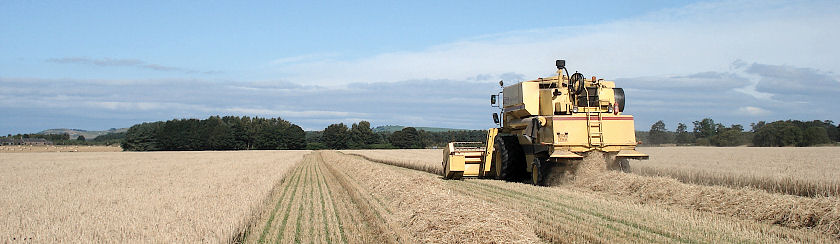
Famously described by Scotland’s national poet Robert Burns, the Lowlands of Scotland are “the most glorious corn country I have ever seen”. The eastern part of the Lowlands particularly are heavily used for agricultural purposes, with grain and barley being grown plentifully ( whisky being an important end product for both). A great amount of grain whiskies are produced in the Lowlands, with most of them finding their way into blends.
The Scottish lowlands are not an officially recognized geographical area of Scotland, but generally refer to the southern parts of Scotland that are not part of the Highlands. The Lowlands and Highlands can considered to be separated by a geological boundary that spans from just north-west of Glasgow (if you want to get more specific, Helensburgh would be the place) to roughly Stirling, and it includes Edinburgh. The actual distinction between the Highlands and Lowlands first was made in the Wash Act of 1784, which determined that Highland whisky would be taxed based on the capacity of the still, whereas in the Lowlands, duty would be raised per gallon on the wash.
Coal and ironstone are some of the sediments that were common in the Lowlands. There’s also been significant volcanic activity in the past. The lack of brine in the soil, combined with the carboniferous rock (shale and sandstone mostly) tends to lead to its waters being nice and crisp. Lowland whiskies are characteristically lighter and fresher (traditionally this could be explained by the triple distillation that removes most of the rough edges from the spirit – a process only Auchentoshan uses nowadays) , flower- or heather-ish, and a bit malty or grassy in taste. They make for excellent beginner whiskies, and are a nice substitute for a glass of wine in the summer evenings.
In the past, several Lowlands distilleries used peat in the kilning process, a practice that had all but disappeared by the mid-20th century as lighter, easier-drinking styles took over. That is no longer the whole story. Annandale produces both an unpeated expression (Man O’Words, named after Robert Burns) and a peated one (Man O’Sword, named after Robert the Bruce) side by side, and Ailsa Bay has built its entire identity around a sweet, heavily peated style unusual for the region, alongside three lighter house characters. It is still a minority style here, but the Lowlands are no longer uniformly smoke-free.
A protected region in its own right
Lowland shares a status that many drinkers overlook: it’s one of only five whisky-producing areas in Scotland with legal protection under the Scotch Whisky Regulations 2009, alongside Highland, Speyside, Islay and Campbeltown. That means a whisky can only be labelled “Lowland” if it was actually distilled here, the same rule that stops a Highland distillery calling itself Speyside. It’s a distinction that matters more than most people realise, because Lowland’s boundary runs along an imaginary line from the Clyde to the Tay, meaning distilleries just a few miles apart can fall on either side of it and be legally barred from using each other’s name.
At its 19th-century peak the region was home to over 100 distilleries, more than any other in Scotland, but that number collapsed to just two or three by the turn of the millennium, a contraction that makes the legal protection feel less like a formality and more like a safeguard for what’s left of a once-dominant tradition.
The Lowlands have changed shape more than any other Scotch whisky region over the past two decades. By the early 2000s only a handful of distilleries were still standing, Auchentoshan, Bladnoch and Glenkinchie chief among the survivors of a long twentieth century of closures. Since then the region has more than tripled in size. Farm distilleries such as Daftmill and Kingsbarns, city distilleries in Glasgow and Edinburgh, and history-led projects such as Lindores Abbey, built on the site of the oldest written record of Scotch whisky distillation anywhere, have all opened within the last fifteen years. A handful of storied old names, Rosebank chief among them, have also come back from the dead. The old idea of Lowland whisky as simply light, floral and beginner-friendly no longer covers the ground it used to.
There currently are a number of active distilleries operating within the Scottish lowlands:
- Aberargie – A working farm in Perthshire where the Morrison family, once owners of Bowmore, grow their own barley and turn it into a single malt without it ever leaving the property
- Ailsa Bay – The Lowlands’ precision-engineered peat: Ailsa Bay measures sweetness and smoke down to the parts per million
- Annandale – Two whiskies, one distillery: peated Man O’Sword and unpeated Man O’Words
- Ardgowan – A sustainably built Lowland distillery on the Firth of Clyde, home of the Infinity Cask.
- Auchentoshan – One of only two Lowland distilleries still triple-distilling the traditional way
- Bladnoch – Scotland’s southernmost distillery, brought back from the brink
- Bonnington – Leith’s whisky revival: meet the distillery built on the ruins of a 15th-century mansion
- Borders Distillery – The first spirit to flow in the Scottish Borders in 181 years, distilled one drop at a time.
- Clydeside – Whisky returns to Glasgow’s docks after a century’s silence
- Daftmill – A working farm that only distills when the harvest allows, and sells out every time it does
- Eden Mill – St Andrews’ own distillery, back home on the Eden Estuary with an exciting new chapter underway.
- Falkirk Distillery – The family-run newcomer bringing whisky back to the Falkirk area after three decades.
- Galloway Distillery – From craft gin shed to Sam Heughan’s whisky homecoming: meet Galloway Distillery
- Glasgow Distillery – Glasgow’s first new whisky maker since the 1900s
- GlenKinchie – Edinburgh’s malt, made 15 miles outside the city
- Holyrood – The first new distillery in Edinburgh in almost a century
- InchDairnie – One of only two Scotch distilleries using a hammer mill instead of a mash tun
- Jackton – A family farm turned grain-to-glass distillery, now home to the award-winning RAER whisky range
- Kingsbarns – A working farm distillery next door to the home of golf
- Lindores Abbey – Built on the site of Scotch whisky’s oldest written record
- Lochlea – Grown, distilled and matured on a single Ayrshire farm
- Moffat – The only distillery in Scotland heating its stills with wood instead of steam
- Port of Leith – Edinburgh’s whisky, built straight up
- Rosebank – The “King of the Lowlands,” silent for 25 years, now distilling again
- Stirling Distillery – Bringing whisky back to Stirling for the first time since 1852, distilled by hand at the foot of the Castle
Inactive distilleries include:
- Glen Flagler
- Inverleven
- Kinclaith
- Ladyburn
- Littlemill
- St. Magdalene