A booming industry
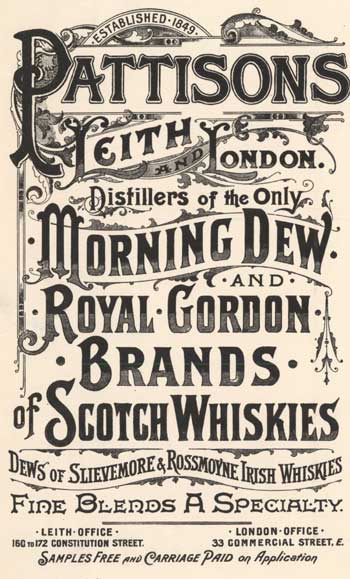
With these parameters in place, the whisky industry boomed. New distilleries were formed, while existing ones were expanded or modernised. For quite some time, the sky appeared to be the limit. Banks were all too happy lending money to whisky-entrepreneurs, and for the Pattison brothers cash was easily obtained. Having achieved great success in the blending business, the brothers decided to move to distillation, and founded Pattisons Ltd in 1896. The new venture saw great success, and the brothers quickly expanded their hold on the industry. They secured half the shares in the Glenfarclas distillery, as well as acquired stocks in the Oban, Aultmore–Glenlivet, and Ardgowan grain distilleries. They also decided to hedge their risk by diversifying into other industries, by purchasing the Duddingston Brewery in Edinburgh.Advertising
While whisky was one aspect of their business, perhaps the brothers achieved most fame with advertising. Pattisons Ltd spent astonishing amounts on marketing and sales. In 1897 they reportedly spent GBP 20,000 on marketing. In those days, that would have allowed them to buy or build a distillery. The year after they even spent as much as GBP 60,000. Perhaps their most famous heist was when they purchased 500 African Grey parrots from a captain whose ship had picked them up in Africa. The brothers insisted that the parrots be taught to say “Buy Pattisons whisky”, and subsequently gave them out to vendors selling their whisky. All the riches led to the brothers leading exorbitant and flamboyant lifestyles. They bought mansions and spent money on all kinds of luxuries. A favourite tactic of theirs was deliberately missing trains and instead booking a private, expensive train to get them to their meetings. They would call in advance, to ensure the press would be present to witness these kind of events.The inevitable crash
Unfortunately, much of the success of the brothers was based on borrowed credit, and creative bookkeeping. The company had inflated its profits, committed fraud by blending its produce with cheaper spirits and selling it as “Fine old Glenlivet” premium whisky, and over-valued its properties. It had also defaulted on a number of loans, leading to its stock crashing on December 5, 1898. The brothers ended up dragged through court, charged for 4 counts of fraud and embezzlement in 1901. Within an hour and a half, the court found the brothers guilty; Robert was sentenced to 18 months in prison, while his brother Walter was let off easy with 9 months of jail-time.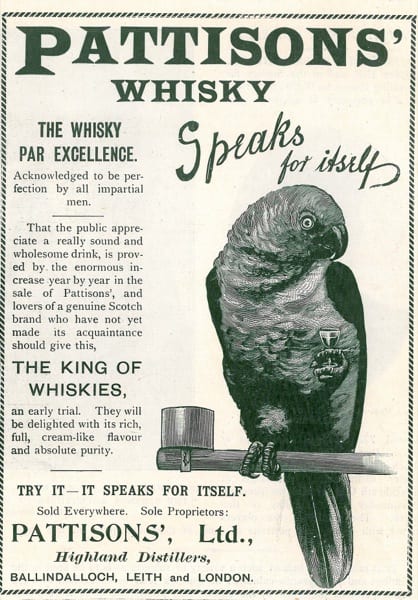
Frequently Asked Questions
Brothers Robert and Walter G. Pattison started out as dairy farmers working for their father’s company in Edinburgh. In the 1880s they realized whisky was more profitable than milk, and partnered with Alexander Elder to found Pattison, Elder & Co, a blending company shipping brands like Morning Dew and Royal Gordon.
Around this time, a phylloxera epidemic devastated vineyards in France, stagnating Cognac production and causing a worldwide brandy shortage. Whisky production surged to fill the gap: new distilleries were founded, existing ones expanded, and banks eagerly lent money to whisky entrepreneurs.
After success in blending, the brothers founded Pattisons Ltd in 1896 to move into distillation. They secured half the shares in the Glenfarclas distillery and acquired stock in the Oban, Aultmore-Glenlivet, and Ardgowan grain distilleries, while diversifying by purchasing the Duddingston Brewery in Edinburgh.
The brothers were known for extravagant advertising, spending £20,000 on marketing in 1897 and £60,000 the next year, enough at the time to buy or build a distillery. Their most famous stunt involved buying 500 African Grey parrots and training them to say “Buy Pattisons whisky” before giving them to whisky vendors. They also lived flamboyantly, deliberately missing trains to book expensive private ones and tipping off the press in advance.
The company’s success was built on borrowed credit and creative bookkeeping. Pattisons had inflated its profits, committed fraud by blending cheaper spirits and selling them as “Fine Old Glenlivet” premium whisky, and over-valued its properties. After defaulting on loans, its stock crashed on December 5, 1898.
The brothers were dragged through court and charged with four counts of fraud and embezzlement in 1901. The court found them guilty within an hour and a half: Robert was sentenced to 18 months in prison, while Walter received a lighter 9-month sentence.
The crash dragged down 10 partner companies and a number of smaller suppliers, caused whisky prices to drop sharply, and forced the newly opened Glen Elgin distillery (established in 1900) to close. Its biggest long-term effect was that no new distilleries were built in Scotland for nearly half a century, the next one, Tullibardine, didn’t open until 1949.