Laphroaig distillery information
Perhaps the most famous of all Islay whiskies, Laphroaig started off modestly in its early days. In 1810, two brothers, Donald and Alexander Johnston leased 100 acres from the laird of Islay for rearing cattle. It is widely believed that besides the cattle, the brothers also did some illicit distilling on the land. In 1815, though, they were granted official licensing, and thus Laphroaig was officially established. In 1836, Donald bought out his brother’s share and became sole owner, with Alexander choosing to migrate to Australia. Donald remained sole owner until his untimely death in 1847, when he drowned in a vat of boiling ale. Ownership then was taken over by his uncle John Johnston who appointed Walter Graham from Lagavulin as distillery manager, as well as employed the help of a local farmer, Peter McIntyre, as Donald’s’ heir was only 11 years old at the time.
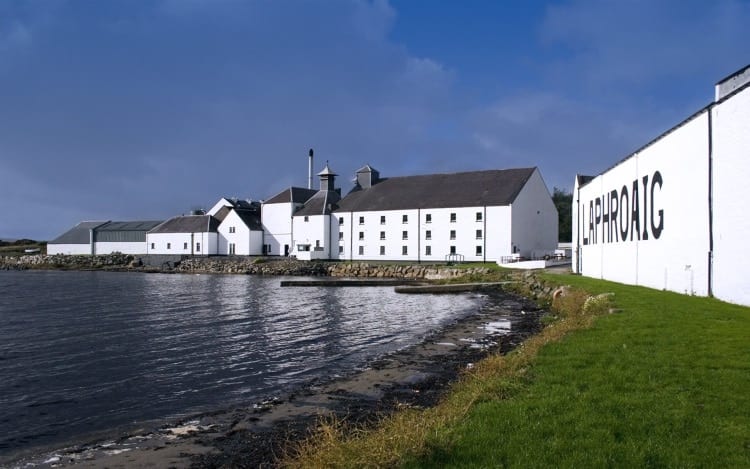
In 1857, the son, Dugald gained ownership, and he received help from his cousin Alexander Johnston. They ran the distillery together until Dugald died in 1877. Alexander died shortly after and left the distillery to his sisters Isabella (Mrs William Hunter) and Katherine Johnston, and his nephew J. Johnston-Hunter. Around this time, Laphroaig had a dispute with a close neighbor (Mackie’s and co) who bought about half the distillery’s production for blending. In 1908, these neighbors attempted to block and divert the water source for Laphroaig. Court action was quickly taken to set this right, but Mackie’s was not done yet. He hired the head brewer from Laphroaig and had replicas of their stills made, in an attempt to simply copy the whisky. Luckily this failed, and despite costing the company a lot of time and money, Laphroaig continued to thrive.
Come 1921, Ian Hunter (The son of William Hunter) took over daily management of the distillery, and in that capacity ended up purchasing the lands, as well as increasing the capacity of the distillery doubling the amount of stills from 2 to 4. Ian Hunter is also credited with being the first of the Scottish distillery owners to start using American Oak barrels. Until then, Spanish oak Sherry casks were the cask of choice for the whisky-makers. Until this very day, first-fill Bourbon casks are used for the maturation at Laphroaig. Ian proved his wits once more when during the American prohibition, he convinced custom officials that due to the iodine smell of the whisky, it surely should be granted medicinal status, which allowed him to continue exporting to the United States.
When Ian passed away without any heirs in 1954, he left the distillery to his trusted secretary Bessie Williamson, who ran the distillery as one of the first (and only) female distillery managers. In the 1960s, recognizing that in order to keep on growing, Laphroaig would need a strong international partner, she sold the distillery to Long John International. 1967 saw the addition of a 5th still. Bessie herself retired in 1972; the same year that 2 more stills were added, bringing the total to 7; the same number as in use today.
In 1990, Allied Domecq acquired the distillery, and their nurturing was crucial in building its reputation as one of Islay’s best-selling whiskies. In 1994, HRH Prince Charles visited the distillery, declaring he thought Laphroaig was “the finest whisky in the world”.
The distillery is now part of Suntory Global Spirits, the renamed successor to Beam Suntory following its 2024 rebrand.
Laphroaig whiskies
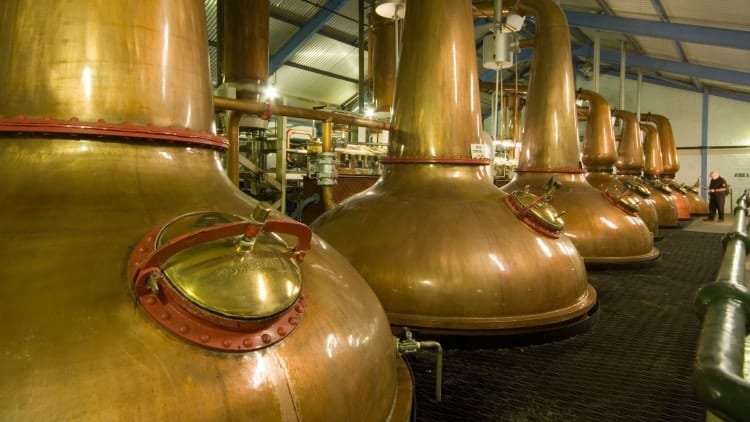
Due to slow heating, the reflux (where vapors fall back into the still, thus achieving additional contact with the copper for maximum chemical reactions) at Laphroaig is minimal. The stills have lyne arms that, rather than pointing down as is common in the industry, actually are sloping upwards, which ensures the heavier oils and flavors fall back into the still. This leads to a light end product (though heavily smokey due to the peating earlier in the kilning process). The 7th still (the 4th spirit still) is used to distill remnants of previous distillations; the foreshots and feints are mixed with a part of low wines, and are then mixed with the spirits collected at the regular distillation. This leads to more balanced product.
The core Laphroaig range consists of the following:
- 10 Year Old; the distillery’s standard bearer, heavily peated, smokey, briny and medicinal.
- 10 Year Old Cask Strength; bottled at natural strength (batch-dependent, typically 55 to 59% abv), not chill filtered.
- Select; a non-age statement whisky matured across Oloroso sherry butts, white American oak hogsheads, PX-seasoned hogsheads, quarter casks and first-fill bourbon casks.
- Quarter Cask; matured first in regular bourbon casks, then transferred into smaller quarter casks for extensive wood interaction and a smoother dram.
- Triple Wood; starts in bourbon barrels, moves to quarter casks, and finishes with a third maturation in ex-Oloroso sherry casks.
- Lore; a marriage of whiskies aged 7 to 21 years across ex-bourbon, European oak, Oloroso sherry and quarter casks, regarded as the richest and most complex expression in the permanent range.
Càirdeas, released annually to Friends of Laphroaig at Fèis Ìle, and the PX Cask, QA Cask and An Cuan Mòr travel-retail exclusives sit outside the core range.
Distillery info:
Detail |
Information |
|---|---|
| Name | Laphroaig |
| Region | Islay |
| Country | Scotland |
| Logo |  |
| Status | Active |
| Founded | 1815 |
| Water source | Kilbride stream |
| Malting floor | No |
| Owned by | Suntory Global Spirits |
| Address |
Laphroaig Distillery |
| Visitor centre | Yes |
| Website | https://laphroaig.com/ |
| https://www.twitter.com/Laphroaig | |
| https://www.facebook.com/laphroaig | |
| Community | Friends of Laphroaig |
| Map |
Distillery Setup:
Component |
Capacity |
Quantity |
|---|---|---|
| Mash tun | 8.5 tonnes | 1 (Lauter tun) |
| Washback | 55,000 litres | 8 (stainless steel) |
| Wash still | 10,400 litres | 3 |
| Spirit Still | 3 * 4,700 + 1 * 9,400 litres | 4 |
| Expected yearly output in LPA (Litres of pure alcohol) | 3,300,000 |
Frequently Asked Questions
Laphroaig is pronounced luh-FROYG, with the stress on the second syllable. The name comes from Scottish Gaelic and is generally translated as “the beautiful hollow by the broad bay.” This is a nod to the distillery’s setting on the Islay shoreline.
In 1810, brothers Donald and Alexander Johnston leased 100 acres from the laird of Islay for rearing cattle, and are widely believed to have also done some illicit distilling on the side. They were granted an official license in 1815, officially establishing Laphroaig. In 1836, Donald bought out his brother’s share and became sole owner, while Alexander emigrated to Australia.
Donald remained sole owner of Laphroaig until his death in 1847, when he drowned in a vat of boiling ale. Ownership passed to his uncle John Johnston, who appointed Walter Graham from Lagavulin as distillery manager and enlisted local farmer Peter McIntyre’s help, since Donald’s heir was only 11 years old at the time.
Yes. Around the turn of the 20th century, Laphroaig had a dispute with neighbouring Mackie & Co, who bought about half the distillery’s production for blending. In 1908, Mackie’s attempted to block and divert Laphroaig’s water source, which was resolved through court action. Mackie then hired away Laphroaig’s head brewer and had replicas of its stills built in an attempt to copy the whisky, but the attempt failed, and Laphroaig continued to thrive.
Ian Hunter, who took over daily management in 1921 and later bought the land outright, doubled the number of stills from two to four and was the first Scottish distillery owner to use American oak barrels, a practice still used for maturation today. During American Prohibition, Hunter convinced customs officials that Laphroaig’s iodine-like smell meant it should be granted medicinal status, allowing him to keep exporting to the United States.
When Ian Hunter died without heirs in 1954, he left the distillery to his trusted secretary, Bessie Williamson, who became one of the first and only female distillery managers in Scotland. Recognising in the 1960s that Laphroaig needed a strong international partner to keep growing, she sold the distillery to Long John International before retiring in 1972, the same year the distillery reached its current total of seven stills.
Yes. During a 1994 visit to the distillery, HRH Prince Charles declared Laphroaig “the finest whisky in the world”.
Allied Domecq acquired Laphroaig in 1990, helping build its reputation as one of Islay’s best-selling whiskies. The distillery is now part of Suntory Global Spirits, the renamed successor to Beam Suntory following its 2024 rebrand.
Laphroaig’s stills heat slowly, producing minimal reflux, and their lyne arms slope upwards rather than pointing down as is common elsewhere, letting heavier oils and flavours fall back into the still. This produces a light spirit that’s nonetheless heavily smoky, due to peating earlier in the kilning process. A seventh still, the fourth spirit still, is used to redistil the foreshots and feints from previous runs mixed with some low wines, which are then blended back with the regular distillation for a more balanced final product.
The core range includes the 10 Year Old, the distillery’s heavily peated, smoky, briny and medicinal standard bearer; a 10 Year Old Cask Strength, bottled at natural strength and not chill filtered; Select, a non-age-statement whisky matured across Oloroso sherry butts, white American oak hogsheads, PX-seasoned hogsheads, quarter casks and first-fill bourbon casks; Quarter Cask, matured first in regular bourbon casks then transferred to smaller quarter casks; Triple Wood, matured in bourbon barrels, then quarter casks, then finished in ex-Oloroso sherry casks; and Lore, a marriage of whiskies aged 7 to 21 years across ex-bourbon, European oak, Oloroso sherry and quarter casks, regarded as the richest expression in the permanent range. Cairdeas, released annually to Friends of Laphroaig at Feis Ile, and the PX Cask, QA Cask and An Cuan Mor travel-retail exclusives sit outside the core range.
Yes, Laphroaig has a visitor centre.