Cardhu distillery information
Officially founded in 1824, the Cardhu (or as it was known back then “Cardow”, translating as “Black rock” from Gaelic) distillery actually had been producing whisky earlier, albeit illegally. In 1811, John and Helen Cumming leased Cardow farm in the Speyside region, and it wasn’t long before long John tried his luck at distilling. Whenever officials came around to check for any illegal distillation, Helen would convince them she was simply preparing to make bread. She didn’t always manage, though, and John was convicted three times for unlicensed distilling. After it became possible to get an official license in 1823, John applied and received a license in 1824, and thus went legit. When John died in 1839 (1846 is sometimes mentioned as well), his son Lewis Cumming took over. Lewis in turn was succeeded by his wife Elizabeth in 1872.
Elizabeth rebuilt the distillery in 1884, leasing additional land in order to expand the business. The old stills were sold to William Grant, who was looking for stills for his Glenfiddich distillery. By 1888, Cardow was being sold as Single Malt whisky in London, leading to quite the interest in the distillery from investors wanting to take over the company. Elizabeth always refused, wishing to keep the distillery in the family. Eventually, though, in 1893, Elizabeth decided to sell the distillery to Canadian firm John Walker & Sons, big customers of the distillery, on the condition her son John Cumming would join the board of John Walker, and could continue running the distillery. Elizabeth unfortunately passed away unexpectedly the year after.
In 1899, the town of Knocknando was fitted with a new railway station, which made distribution of Cardhu whisky cheaper. The distillery also was upgraded, receiving a second pair of stills, a larger mash tun, and an enlarged tun room which would ensure additional washbacks could be put in. Additional work was done in 1902; this time adding a steam engine and boiler, as well as replacing the worm tubs with condensers.
The distillery was closed between 1917 and 1919 when World War I saw restrictions imposed on barley usage, but it resumed production in October 1919. In 1923, John Cummings retires from the board, with his son Ronald Cumming replacing him. In 1925, John Walker & Sons would join Distillers Company Limited (DCL), who then transferred the distillery to Scottish Malt Distillers (SMD) in 1930. Between 1960 and 1961 the distillery is largely rebuilt and extended, with a third pair of stills added, and the whisky is relaunched as a single malt. All stills were switched to steam heating in 1971, and in 1981, the brand name was officially changed to Cardhu.A visitor centre was opened in the same year.
The distillery is nowadays owned by Diageo, which is a continuation of United Distillers, who took over SMD through mergers. Cardhu is the 6th best selling Single Malt whisky in the world and is especially popular in Southern Europe (mostly Spain). To cope with rising demand, in 2003, Diageo took the step of silently switching Cardhu from a Single Malt (meaning all whisky is produced at a single distillery) to a vatted malt (which contains several malt whiskies from different distilleries), in virtually identical bottles. The whisky industry and consumers took note, and a strain of bad publicity led to the withdrawal of the Vatted Malt.
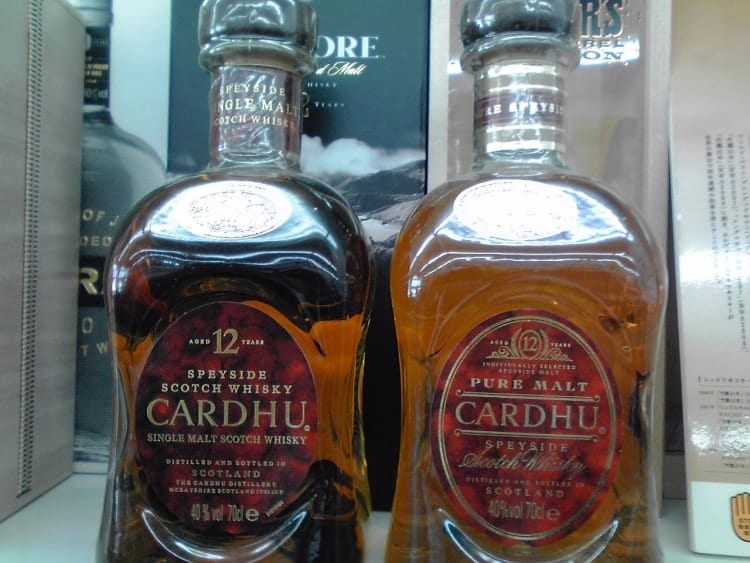
The good thing coming out of this affair was a new set of regulations that defined under the conditions under whisky should be labelled in 2005. 2005 was also the year that Diageo added Cardhu to their Classic Malts series.
Cardhu Whiskies
Cardhu forms the backbone of the Johnnie Walker blends (Red, Black, Green, and Blue label). However, there is quite an extensive range (for a Diageo distillery at least) available:
- 12 Year Old
- 15 Year Old
- 18 Year Old
- Special Cask Reserve
- Rare Malts; 25 Years Old (launched in 1998)
- Rare Malts; 27 Years Old (launched in 2000)
- 22 Year Old (Special release, 2005)
- 21 Years Old (Special release 2013)
Distillery info:
Detail |
Information |
|---|---|
| Name | Cardhu |
| Region | Speyside |
| Country | Scotland |
| Logo | |
| Status | Active |
| Founded | 1824 |
| Water source | Sources in the Mannoch Hills and Lyne Burn |
| Malting floor | No |
| Owned by | Diageo |
| Address |
Cardhu Distillery +44 (0) 1479 874635 |
| Visitor centre | Yes |
| Website | http://www.discovering-distilleries.com/cardhu |
| https://www.facebook.com/Cardhu | |
| Community | Friends of Classic Malts |
| Map |
Distillery Setup:
Component |
Capacity |
Quantity |
|---|---|---|
| Mash tun | 7 tonnes | 1 (Full Lauter) |
| Washback | 37,000 litres | 8 (Larch) |
| Wash still | 18,000 litres | 3 |
| Spirit Still | 11,000 litres | 3 |
| Expected yearly output in LPA (Litres of pure alcohol) | 3,000,000 |
Frequently Asked Questions
Cardhu is pronounced kar-DOO. The name comes from Scottish Gaelic “Carn Dubh,” meaning “black rock.”
Cardhu was originally known as “Cardow,” a name that translates from Gaelic as “Black rock.” The distillery officially adopted the Cardhu spelling in 1981.
Cardhu was officially founded in 1824, when John Cumming received a license to distill legally, having leased Cardow farm in Speyside with his wife Helen back in 1811.
Yes. John Cumming had been distilling illegally for years before licensing became possible in 1823; he was convicted three times for unlicensed distilling, while his wife Helen would try to convince excise officials she was simply baking bread whenever they came to check.
Yes. When Elizabeth Cumming rebuilt Cardhu’s distillery in 1884, she sold its old stills to William Grant, who was looking for equipment for his new Glenfiddich distillery.
Cardhu is owned by Diageo, a continuation of United Distillers, which took over Scottish Malt Distillers (the company Cardhu had been transferred to in 1930) through mergers. Diageo added Cardhu to its Classic Malts series in 2005.
To cope with rising demand in 2003, Diageo quietly switched Cardhu from a single malt to a vatted malt (blending in whisky from other distilleries) sold in virtually identical bottles. This drew bad publicity once discovered, leading Diageo to withdraw the vatted malt; the episode also helped prompt new UK regulations in 2005 defining how whisky must be labelled.
Cardhu forms the backbone of the Johnnie Walker blends, including the Red, Black, Green, and Blue labels, and is the 6th best-selling single malt whisky in the world, especially popular in Southern Europe (mainly Spain).
Yes, Cardhu has a visitor centre, which opened in 1981, the same year the brand officially adopted the Cardhu name.